In HR+/HER2- metastatic breast cancer (mBC), 1L treatment response is critical as PFS becomes significantly shorter with each subsequent line of mBC treatment.1,2
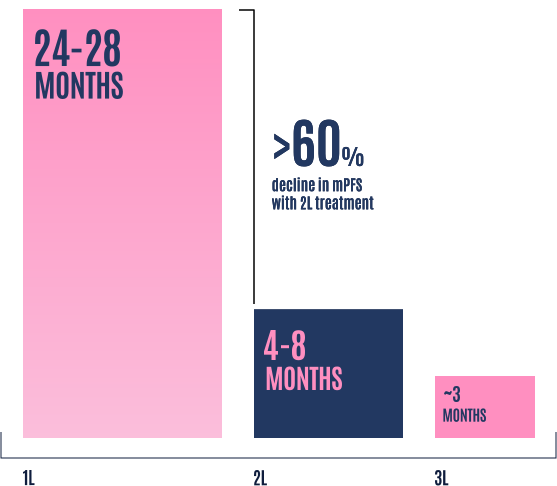
mPFS in metastatic breast cancer declines with each line of treatment3-12*

mPFS in Metastatic Breast Cancer graph mPFS in Metastatic Breast Cancer graph

Benefit from ET may start declining while on 1L.13-15

*PFS ranges for 1L and 2L were based on phase 2/3 clinical trials evaluating endocrine therapy (ET) + targeted therapy regimens.3-8,10,11 PFS for 3L was based on phase 3 clinical trial data evaluating chemotherapy regimens.9,12

Start icon of quoteLorem ipsum dolor sit amet, consectetur adipiscing elit, sed do eiusmod tempor incididunt ut labore et dolore magna aliqua. Ut enim ad minim veniam.End icon of quote

Lana Reynolds, MD
MD Anderson Cancer Center

There is a growing need to prolong time on 1L because efficacy declines >60% in 2L.3-8,10,11

Start icon of quoteEndocrine therapies such as aromatase inhibitors have been around for a long time. We’ve been improving on the targeted therapy front, but it’s also important to optimize the endocrine therapies.End icon of quote

Jason A. Mouabbi, MD
MD Anderson Cancer Center

First Line Icon

What potential might innovative approaches to the 1L endocrine therapy backbone have for patients?

1L=first line; 2L=second line; 3L=third line; CDK4/6i=cyclin-dependent kinase 4/6 inhibitor; HER2-=human epidermal growth factor receptor 2-negative; HR+=hormone receptor-positive; mPFS=median PFS; PFS=progression-free survival.


  1. Yamamura J, Kamigaki S, Tsujie M, et al. Response to first-line recurrence treatment influences survival in hormone receptor-positive, HER2-negative breast cancer: a multicenter study. In Vivo. 2019;33(1):281-287. doi:10.21873/invivo.11473
  2. Matikas A, Kotsakis A, Perraki M, et al. Objective response to first-line treatment as a predictor of overall survival in metastatic breast cancer: a retrospective analysis from two centers over a 25-year period. Breast Care (Basel). 2022;17(3):264-271. doi:10.1159/000519729
  3. Kalinsky K, Accordino MK, Chiuzan C, et al. Randomized phase II trial of endocrine therapy with or without ribociclib after progression on cyclin-dependent kinase 4/6 inhibition in hormone receptor–positive, human epidermal growth factor receptor 2–negative metastatic breast cancer: MAINTAIN trial. J Clin Oncol. 2023;41(24):4004-4013. doi:10.1200/JCO.22.02392
  4. Johnston S, Martin M, Di Leo A, et al. MONARCH 3 final PFS: a randomized study of abemaciclib as initial therapy for advanced breast cancer. NPJ Breast Cancer. 2019;5:5. doi:10.1038/s41523-018-0097-z
  5. Finn RS, Martin M, Rugo HS, et al. Palbociclib and letrozole in advanced breast cancer. N Engl J Med. 2016;375(20):1925-1936. doi:10.1056/NEJMoa1607303
  6. Mayer EL, Ren Y, Wagle N, et al. PACE: a randomized phase II study of fulvestrant, palbociclib, and avelumab after progression on cyclin-dependent kinase 4/6 inhibitor and aromatase inhibitor for hormone receptor-positive/human epidermal growth factor receptor-negative metastatic breast cancer. J Clin Oncol. 2024;42(17):2050-2060. doi:10.1200/JCO.23.01940
  7. Llombart-Cussac A, Harper-Wynne C, Perello A, et al. Second-line endocrine therapy (ET) with or without palbociclib (P) maintenance in patients (pts) with hormone receptor-positive (HR[+])/human epidermal growth factor receptor 2-negative (HER2[-]) advanced breast cancer (ABC): PALMIRA trial. J Clin Oncol. 2023;41(16_suppl):1001. doi:10.1200/JCO.2023.41.16_suppl.1001
  8. Kalinsky K, Bianchini G, Hamilton E, et al. Abemaciclib plus fulvestrant in advanced breast cancer after progression on CDK4/6 inhibition: results from the phase 3 postMONARCH trial. J Clin Oncol. 2025;43(9):1101-1112. doi:10.1200/JCO-24-02086
  9. Cortes J, O'Shaughnessy J, Loesch D, et al. Eribulin monotherapy versus treatment of physician's choice in patients with metastatic breast cancer (EMBRACE): a phase 3 open-label randomised study. Lancet. 2011;377(9769):914-923. doi:10.1016/S0140-6736(11)60070-6
  10. Turner NC, Oliveira M, Howell SJ, et al. Capivasertib in hormone receptor-positive advanced breast cancer. N Engl J Med. 2023;388(22):2058-2070. doi:10.1056/NEJMoa2214131
  11. Hortobagyi GN, Stemmer SM, Burris HA, et al. Updated results from MONALEESA-2, a phase III trial of first-line ribociclib plus letrozole versus placebo plus letrozole in hormone receptor-positive, HER2-negative advanced breast cancer. Ann Oncol. 2018;29(7):1541-1547. doi:10.1093/annonc/mdy155
  12. Yuan P, Hu X, Sun T, et al. Eribulin mesilate versus vinorelbine in women with locally recurrent or metastatic breast cancer: a randomised clinical trial. Eur J Cancer. 2019;112:57-65. doi:10.1016/j.ejca.2019.02.002
  13. Fribbens C, Murillas IG, Beaney M, et al. Tracking evolution of aromatase inhibitor resistance with circulating tumour DNA analysis in metastatic breast cancer. Ann Oncol. 2018;29(1):145-153. doi:10.1093/annonc/mdx483
  14. Clatot F, Perdrix A, Beaussire L, et al. Risk of early progression according to circulating ESR1 mutation, CA-15.3 and cfDNA increases under first-line anti-aromatase treatment in metastatic breast cancer. Breast Cancer Res. 2020;22(1):56. doi:10.1186/s13058-020-01290-x
  15. Bidard FC, Hardy-Bessard AC, Dalenc F, et al. Switch to fulvestrant and palbociclib versus no switch in advanced breast cancer with rising ESR1 mutation during aromatase inhibitor and palbociclib therapy (PADA-1): a randomised, open-label, multicentre, phase 3 trial. Lancet Oncol. 2022;23(11):1367-1377. doi:10.1016/S1470-2045(22)00555-1